

Dr Umakant .s
Professor &HOD
Department of Management
CMS- UG studies
Mr Avinash Raj David
Assistant professor
Department of Management
CMS- UG studies
Jain (Deemed- to – be) University, Center for Management Studies
Deepali Taparia, Pankaj Ray, Ananya Prakash, Madhur Agrawal, Aditya Shivakumar
(20BBAR0838) (20BBAR0 ) (20BBAR0724 ) (20BBAR0033 ) (20BBAR0 )
Abstract
The population and economy of Bengaluru are expanding, which has led to a variety of problems with the generation and disposal of solid garbage. As a result of the situation, the state government has implemented policies and programmes to promote recycling and environmentally friendly solid waste management. Solid waste management and recycling in Bangalore is a thriving business with many different stakeholders and technological advancements. This abstract provides a summary of the solid waste management and recycling sector in Bengaluru, together with details on key players, challenges, and future possibilities. Additionally, it discusses how community involvement, corporate sector involvement, and governmental rules and regulations all work together to promote state-wide sustainable waste management strategies.
The solid waste management and recycling sector is a significant and growing economic sector that is vital to halting environmental deterioration and safeguarding natural resources. The need for sustainable waste management and recycling solutions is increasing as awareness of environmental degradation, climate change, and resource depletion grows on a global scale across various sectors, according to this company, which also collects, processes, and disposes of waste. Clean environment, starting new businesses, and recycling recyclable garbage are the key words.
INTRODUCTION
In essence, recycling is the third step in the “Reduce, Reuse, and Recycle” waste hierarchy and is a crucial part of contemporary trash reduction. By eliminating raw material intake and rerouting waste output in the economic system, it fosters environmental sustainability. The recycled materials act as replacements for raw materials derived from increasingly depleted natural resources like oil, gas, coal, mineral ores, and forests. Recycling can aid in lowering the amount of solid waste dumped in landfills, which are becoming more and more expensive. Recycling also lessens the pollution of the air, water, and land caused by the dumping of garbage.
Typically The processes and actions necessary to manage garbage from its creation to its eventual disposal are included in waste management (also known as waste disposal). This covers waste collection, transportation, treatment, and disposal as well as the oversight and control of the waste management procedure and any legislation, technology, or economic mechanisms that are related to trash. Accordingly, a recycling business is a sort of enterprise that derives revenue from the collecting of various items for recycling. Many towns and localities have one type or another of recycling business that makes money by gathering various things to recycle. Less waste ends up in our landfills and incinerator facilities the more we recycle. We can reduce production and energy costs, as well as the damaging effects that the extraction and processing of virgin materials have on the environment, by reusing resources like aluminum, paper, glass, plastics, and other items.
Recycling is the process of separating, recovering, and reusing solid waste components that may still be economically valuable. Since composting recovers the organic components of solid waste for reuse as mulch or soil conditioner, it can also be viewed as a recycling process. Other waste products might be put to good use again.
The fast urbanization and population growth of Bengaluru makes managing solid waste a serious concern. An estimated 4,000 tonnes of waste, both biodegradable and non-biodegradable, are produced daily in Bengaluru. The city’s poor garbage collection and management facilities contribute to the buildup of trash on the streets, which results in a number of environmental and health issues. Several actions have been taken by the government and different stakeholders to solve this problem, but more must be done to achieve sustainable waste management.
Review of literature
Rajkumar Joshi & Sirajuddin Ahmed (2016)
The current state of MSWM (Municipal Solid Waste Management) in India’s states and major cities is also examined in their report, “Status and challenges of municipal solid waste management in India.” Exploration is also done into the necessary conditions for maximising the advantages of public-private partnerships, as well as the challenges and unacknowledged role of rag-pickers. According to the report, it is crucial to build decentralised facilities for processing solid waste in large cities and towns in developing countries like India, as well as to expand the formal recycling industrial sector.
RajithKharvelAnnepu (2012)
The study “Sustainable Solid Waste Management in India” explains that better ways of disposing of municipal solid waste (MSW) in India were investigated, as well as the current state of waste management in the country, its effects on public health and the environment, and the likelihood of adoption. The main objective of the study was to look at ways to reduce the enormous volume of solid waste that is now being dumped on land via economically and environmentally responsible means of recovering materials and energy from trash. In order to research the potential of this technology in India, the author has also travelled to other WTE facilities in the US. These visits gave us the chance to extensively examine how waste management initiatives—or lack thereof—have affected the local populace in those cities.
Isher Judge Ahluwalia & Utkarsh Patel (2018)
The environmental and economical sustainability of solid waste management in Indian cities is studied in this study, which is titled “Solid Waste Management in India an Assessment of Resource Recovery and Environmental Impact”. It looks at the fast-rising amount of municipal solid waste, its shifting makeup, the practice of mixing biodegradable (wet) and dry waste at the place of formation, and the rising amount of plastic waste. The current system is primarily concerned with the collection and transportation of mixed, unsorted waste. The safe disposal of residual waste in landfills with sound engineering is greatly neglected, as well as resource recovery from waste. This report also lists the sources of greenhouse gas emissions from the solid waste industry. It also recommends ways for ensuring that the system is financially sustainable, in addition to giving some mitigation options to respond to the developing difficulty.
Abhishek Nandan, B. P. Yadav, Soumyadeep B. &Debajyoti Bose (2017)
The management of municipal solid waste at the moment is explained in the research “Recent Scenario of Solid Waste Management in India” below. It also emphasizes a concerted, methodical effort to improve Integrated SWM system participation from the general public, institutional structures, financial provisions, technology, operations management, and human resource development. In India, managing solid waste is done in a mostly unscientific manner. According to Sharholy et al. (2007), solid waste collection effectiveness is only about 70% in India while it is 100% in wealthy nations. Today, a sizable portion of solid waste is still discarded. On the outskirts of towns or cities, without any prior treatment, without discrimination. As a result, the groundwater becomes contaminated. Contamination and air pollution have increased as a result of leachate percolation and gas release. increased respectively.
DimpalVij (2012)
The study “Urbanization and Solid Waste Management in India: Present Practices and Future Challenges” focuses on the impending trends in urbanization in India and the resulting garbage output. The current research assesses the methods used currently in India to manage this solid waste and the issues related to it. It also outlines the steps to take to deal with this trash in a healthy and environmentally responsible way so that it might end up being a resource rather than waste. Urbanization is currently a worldwide phenomenon that directly adds to trash generation. Unscientific waste disposal results in health risks and the degradation of urban environments. This issue has gotten worse due to financial restrictions, institutional deficiencies, poor technology choices, and public indifference to Municipal Solid Waste (MSW).
Mahajan Niyati (2015)
Municipal solid waste management (SWM) practices and laws in India and Japan are compared in the paper “Municipal Solid Waste Management in India and Japan” that follows. Developing nations like India have the opportunity to benefit from Japan’s experience, but they must realistically evaluate what to expect from SWM systems. To ameliorate the trash situation, India must employ the most appropriate disposal methods, put more emphasis on recycling, and incorporate the unorganized sector. There are four sections in the essay. The rules governing waste management in Japan and India are briefly described in Section I. The quantity and makeup of the waste are the main topics of Section II. The existing methods of waste management in both countries have been analyzed in Section III.
R K Ganguly&Susanta Kumar Chakraborty (2021)
The current study “Integrated approach in municipal solid waste management in COVID-19 pandemic” aims to highlight the difficulties the current waste management system has in addressing the massive waste generation. India, a developing nation, is second in the world for COVID positive cases, which has caused a significant increase in the production of biomedical waste. The current study has therefore attempted to highlight and discuss all those newly created problems in light of the ongoing global pandemic and the necessity of formulating strategies integrating various traditional, modern, and newly proposed waste management strategies to tackle the deteriorating environmental problems, particularly in respect to generation, collection, disposition, and recycling of enormous amounts of municipal solid wastes along with evaluating various guide of municipal solid wastes under this global crisis.
R Ganguly (2016)
This paper “E-Waste Management in India” aims to give a brief insight into this concept of e-waste, its generation in India, and the environmental and health concerns attached to it. Additionally, it highlights the e-waste recycling economy in the existing informal and the nascent formal sector and the urgent need for more defined legislation and strategies to tackle this problem.
P Somani, R D Navaneethan & S Thangaiyan (2021)
The study paper “Integrated solid waste management in Urban India” discusses the current situation, difficulties, and implementation of waste reduction processes, such as segregation/collection, recycling, energy recovery (composting, bio methanation, and bioremediation), and land filling of household and industrial waste, as well as the effects on the environment. This assessment comes to a close with some straightforward and practical global waste management trends, with the goal of strengthening existing Indian systems. India confronts a significant difficulty every year as it deals with municipal solid trash, which amounts to over 62 million Tonnes annually and includes E-waste, plastic, and medical waste. The threat to public and environmental health has grown and is now present. In India, sustainable development is primarily included into solid waste management.
P Vasanthi, S Kaliappan & R Srinivasaraghavan (2007)
The study “Impact of poor solid waste management on ground water” unequivocally shows that ground water monitoring should be done regularly at landfills in highly populated cities. Furthermore, unless it satisfies certain criteria, ground water near garbage sites is forbidden to be used for drinking. Waste should not be dumped randomly in developed regions without effective solid waste management procedures. Water samples were taken at different radial distances from the dumping yard’s boundaries, and chemical analysis was done on them at 3-month intervals throughout a 3-year period. The investigation also showed that the quality of ground water did not meet Bureau of Indian Standards requirements for drinking water. The effects of dumping activity on ground water appeared most clearly as high concentrations of total dissolved solids, electrical conductivity, total hardness, chlorides, chemical oxygen demand, nitrates and sulphates.
STATEMENT OF PROBLEM
For many years, Bengaluru, the capital of Karnataka, India, has struggled to effectively manage its solid waste. Approximately 4,000–5,000 tonnes of rubbish are produced in the city every day, however only 60–70% of this waste is collected and taken to landfills. The remainder of the waste is either thrown out in the open or left on the streets without being picked up, posing major health and environmental risks. There is an urgent need for a more sustainable and all-encompassing strategy because the city’s current solid waste management system is insufficient and ineffective.
This study paper’s main goal is to examine the difficulties and opportunities facing Bengaluru’s solid waste management system and offer feasible solutions to boost its effectiveness and viability. The goal of the study paper is to present a thorough understanding of Bengaluru’s solid waste management system and to help design future waste management plans for the city that are both efficient and sustainable.
OBJECTIVE OF STUDY
1To examine theOppurtunites of the business and develop a new recycling business.
2.To find recycle solid waste into useful things or we can generate new products from solid waste.
3.To examine the process of generating money.
4.To analyze the current market of recycling business.
5.To analyze the scope of recycling businesses in the future and examine the latest technologies used by the companies for recycling.
SCOPE OF THE STUDY
The scope of solid waste management in Bengaluru involve the comprehensive approach to the collection, transportation, treatment and disposal of solid waste generated. The Karnataka state pollution control board (KSPCB) is responsible for implementing and enforcing the solid waste management rules,2016 which aims to promote waste minimization, resource recovery and environmentally sound disposal practices. It also includes public education and awareness programs. In addition the government is working on building sustainable waste management infrastructure, including waste- to – energy plants, composting facilities, and sanitary landfills, to effectively manage the increasing amount of waste generated in the city.
METHODOLOGY
To research on solid waste management in Bengaluru, the team did the research based on tries and tested data which is previously analyzed and filtered. The data which fits our research which selected and used. The data collected were customized according to our need.
LIMITATIONTO SWM
1) The high cost of garbage delivery is a significant limitation. Although it is required, transporting waste products from houses to processing plants is very expensive.
2) Another constraint is the haphazard placement of trash.
3) Karnataka faces considerable environmental issues as a result of high garbage output and insufficient trash collection, transport, treatment, and disposal. The amount of waste created by a rising urban population in Karnataka exceeds the capacity of the state’s current infrastructure, which has detrimental impacts on the environment and public health.
4) The fact that not all materials can be recycled and those that can only go through a limited number of cycles owing to degradation each time is the biggest obstacle to recycling. The phrase used to characterize this deterioration is “down cycling.” Recycling also raises a number of several social and ethical concerns.
DATA ANALYSIS AND INTERPRETATION
1. WASTE GENERATION : BENGELURU

(Source: intechopen)
At present about 10% of the waste is recycled in Bengaluru. After 1990 the composition of India has changed drastically. At present, the waste generation is about 5000 metric tonns, and the waste generation is likely to grow over the upcoming years. Going by the present trend of increase in the quantity of waste, the waste quantity projected for next 20 years is shown in the graph.
2. KINDS OF MUNICIPAL WASTE
(Source: International Journal of Engineering Research & Technology (IJERT)
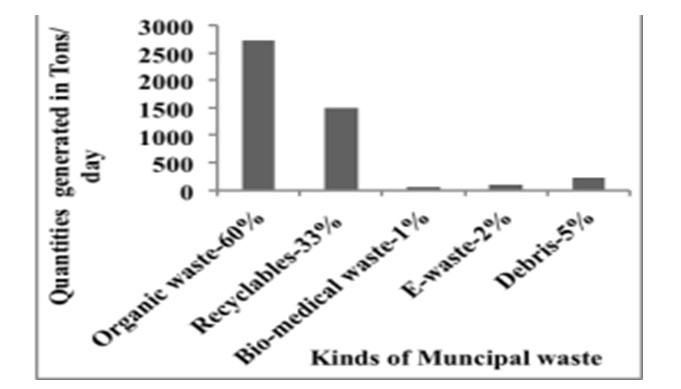
The following graph shows the breakdown of the 5000 tonnes of waste generated in bengaluru on a daily basis. We understand that the majority of the waste generated comprises of organic waste. Followed by recyclable waste. Only a small percentage of waste generated belong to the categories of medical, e-waste, and miscellaneous waste.
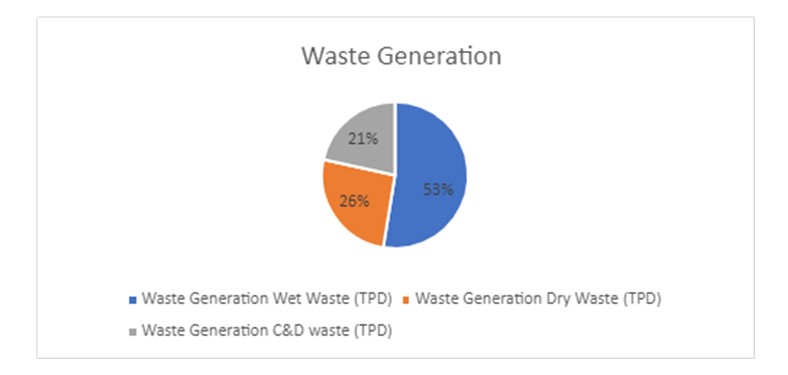
3. WASTE GENERATION: BENGALURU
(Source: Karnataka Economic Survey)
Waste Generation

4. WASTE DISPOSAL PRACTICES IN BENGALURU
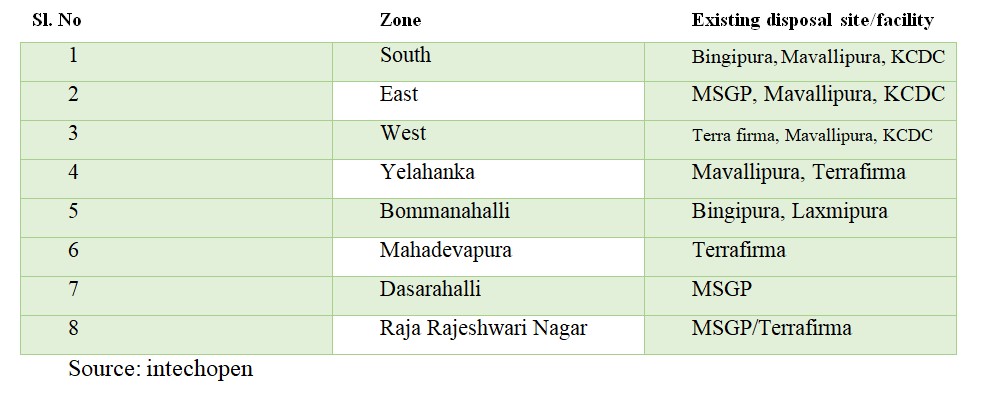
The above mentioned are the zones in Bengaluru with their disposal sites/facilities. These zones are the Mazor waste producer.
4. DIVISIONAL WISE TOTAL WASTE
Source: SWM (bbmp.gov.in)
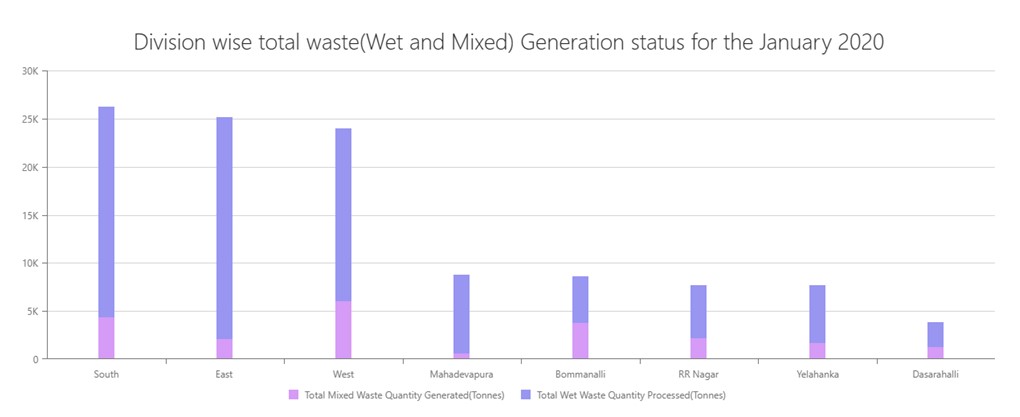
The above graph shows the divisional wise total waste collected. There are in total of 8 zones in bengaluru. And the maximum waste collected is from south west and east receptively, and the least waste collected fromDasarahalli
FINDINGS
- There are less disposal places, which provokepublic to depose the waste (wet and dry )in the empty landfills that is hazardous to environment and public health .
- There is air and water pollution, land degradation, emissions of methane and hazardous leachate, and climate change.
- Collected wastes lead to the emission of greenhouse gases, which increase the amount of carbon dioxide in the atmosphere, resulting in the heating up of our environment.
SUGGESSIONS
1) Create a State-Level Waste Management Policy: Karnataka is able to create a comprehensive waste management policy for the state that specifies rules for garbage collection, processing, transportation, and disposal. This policy should encourage environmentally responsible waste management techniques and guarantee that all environmental laws are followed.
2) Promote Community Participation: It is crucial for solid waste management to have the support of the community. Using strategies like composting, recycling, and garbage segregation, Karnataka can entice residents to engage in waste management initiatives. Communities that accomplish high levels of garbage segregation and recycling can potentially receive incentives from the state.
3) Increase Private Sector Participation: The private sector may be a key player in Karnataka’s successful solid waste management. The government can entice private businesses to invest in waste infrastructure and to take part in waste management initiatives.
4) Enhance Waste Collection and Transportation: To increase the effectiveness and efficiency of waste management, the state should make investments in cutting-edge waste collection and transportation infrastructure. This involves utilizing smart bins, automated trash sorting facilities, and GPS-enabled waste collection vehicles.
5) Encourage waste-to-energy projects. These initiatives can minimize the amount of rubbish Karnataka sends to landfills and provide renewable electricity. The government can encourage the creation of these initiatives and offer financial rewards to businesses that finance them.
6) Raise Public Awareness: One of the biggest obstacles to the efficient management of solid waste is a lack of public awareness. Karnataka has the ability to conduct major public awareness programmed to inform people of the value of composting, recycling, and trash segregation.
The adoption of these recommendations can encourage environmentally responsible waste management techniques and guarantee that environmental standards are followed.
CONCLUSION
In conclusion, Bengaluru’s solid waste management is a significant challenge that necessitates an all-encompassing strategy. The government has made great efforts to encourage resource recovery, trash minimization, and environmentally sound disposal practices, as well as to execute the 2016 Solid trash Management Rules. However, there is still a need for greater public involvement and awareness as well as the creation of cutting-edge waste management infrastructure and technologies. The public, government organizations, waste management businesses, and other stakeholders can work together to enhance solid waste management procedures and create a cleaner, healthier, and more sustainable environment for its residents.
REFRENCES:
- state Planning Board. Chapter. Environment and Development: Economic Review 2008.
- J. Sin, G. K. Chen, K. S. Long, I. Goh, and H. Hwang, “Current practice of waste management system in Malaysia: Towards sustainable waste management,” 1st FPTP Postgrad. Semin. “Towards Sustain. Manag., 2013.
- Khalid, M. Arshad, M. Anjum, T. Mahmood, and L. Dawson, “The anaerobic digestion of solid organic waste,” Waste Management. 2011.
- Matsakas, Q. Gao, S. Jansson, U. Rova, and P. Christakopoulos, “Green conversion of municipal solid wastes into fuels and chemicals,” Electronic Journal of Biotechnology. 2017.
- I. Abdel-Shafy and M. S. M. Mansour, “Solid waste issue: Sources, composition, disposal, recycling, and valorization,” Egyptian Journal of Petroleum. 2018.
- Senate Economic Planning Office, “Philippine Solid Wastes,” Solid Wastes A Glance, 2017.
- Johari, H. Alkali, H. Hashim, S. I. Ahmed, and R. Mat, “Municipal solid waste management and potential revenue from recycling in Malaysia,” Mod. Appl. Sci., 2014.
- D. M. Samsudin and M. M. Don, “Municipal solid waste management in Malaysia: Current practices, challenges and prospect,” J. Teknol. (Sciences Eng., 2013.
- Arena, “Process and technological aspects of municipal solid waste gasification. A review,” Waste Manag., 2012.
- chun Lee and B. D. Pandey, “Bio-processing of solid wastes and secondary resources for metal extraction – A review,” Waste Management. 2012.
- Pires, G. Martinho, and N. Bin Chang, “Solid waste management in European countries: A review of systems analysis techniques,” Journal of Environmental Management. 2011.
- Fercoq, S. Lamouri, and V. Carbone, “Lean/Green integration focused on waste reduction techniques,” J. Clean. Prod., 2016.
- Ezeah, J. A. Fazakerley, and C. L. Roberts, “Emerging trends in informal sector recycling in developing and transition countries,” Waste Management. 2013.
- G. Paul, J. Arce-Jaque, N. Ravena, and S. P. Villamor, “Integration of the informal sector into municipal solid waste management in the Philippines – What does it need?,” Waste Manag., 2012.
- S. Murthy and M. Madhava Naidu, “Sustainable management of coffee industry by-products and value addition – A review,” Resources, Conservation and Recycling. 2012.
- Victor and P. Agamuthu, “Strategic environmental assessment policy integration model for solid waste management in Malaysia,” Environ. Sci. Policy, 2013.