


*Dr. Umakanth S
Professor & HOD
Department of Management
CMS – UG Studies
*Mr. Avinash Raj David
Assistant Professor
Department of Managemen
CMS – UG Studies
Jain (Deemed-to-be) University, Center for Management Studies
Chirag Bhojania, Swati Kanodia, Sambhav Mehta, Vedika Mehra, Varun Baid
(20BBAR0952) (20BBAR0883) (20BBAR0480) (20BBAR0172) (20BBAR0187)
Abstract: The ICT sector’s mobile phone industry is a tremendously inventive subsegment, and smartphones are quickly replacing other forms of mobile devices as the industry standard. Although if market shares are heavily concentrated in the hands of a very small number of corporations, technological advancement and the emergence of new products have made this industry incredibly dynamic. The current research looks into the possibility of a dominant design in the smartphone market. The study demonstrates that the ability of customers to adopt novel designs limits smartphone innovation. We got to know thatWi-Fi sharing, background noise suppression, and transparent displays are some new features that have received favorable feedbackthat is areound 40% and We can see from the comments that individuals think iOS, the operating system for iPhones, is more secure which is 50%.
Keywords
Innovation, Smartphone, Operating system, Mobile Industry
Introduction :
The phrase “cell phone” refers to a small electrical device that suggests a connection to a cell organization. IBM introduced the world to cell phones in 1994, but companies like Apple and Samsung have since joined the market. In spite of the way that they were initially meant to permit people to impart by means of telephone and email, cell phones currently let folks to get to the web, mess about, and send instant messages as well as settling on telephone decisions and sending messages. A cell phone is a portable electronic device that connects to a mobile network and the Internet. IBM produced Simon, the first cell phone ever created, in 1994.
The introduction of cell phones radically altered the field of media communications. Cell phones were seen as the prototype wireless’s passing sound. In addition to opening up new commercial opportunities, the widespread use of cell phones has accelerated the development of operating systems and technological apparatus.
Network managers relied on the cost structure they relied on for a very long time— calling a different line cost a certain level rate and sending an instant message cost another level rate—before the incorporation of web browsing on mobile devices. to a: to a to. Cell phones were seen as the death knell of the prototypical cell, whereas cells were seen as the passing ring of land-based cellphones.
When consumers realized they could use cell phone-based applications, such as games and informational apps, their interest in cell phones that didn’t provide that utility would decline. In developed economies, interest in cells that fell short of the utility of mobile phones plummeted.
Since then, the smartphone industry has been gradually expanding in terms of market size, models, and suppliers. Global shipments of smartphones are anticipated to reach 1.48 billion devices in 2023. By the year 2020, 46.45% of people on the planet would be smartphone owners. An estimated 6.4 billion smartphone accounts were in use as of 2021, and that number is projected to increase to 7.5 billion by 2026.
And through this research, we’ve gathered comments from people and documented them using technology added to an already-existing smartphone model.
REVIEW OF LITERATURE
- Androulidakis ; G. Kandus (2011) The relationship between users’ security behaviours and their mobile phone brand. Depending on the type of mobile phone they are using, users exhibit varying behavior in a variety of areas. As a result, there is a categorization of regions, unique to each business, where people are obviously weak in security awareness, perhaps as a result of ignorance. Such a classification can assist phone manufacturers in improving the security of their mobile phones, ideally in a clear manner for the user.
- Tajzadeh Namin A. A. ; Rahmani Vahid ; Tajzadeh Namin Aidin (2012) analyzed that situation and content may have an impact on the decision-making (choosing) process when it comes to brands. The data reveal a substantial link between the variables “brand attitude”, “company attitude”, and “product (cell phone) choice”. Moreover, no connection was discovered between the individual decision-making processes (independent or mediated) and product choice.
- Serkan Aydin, Gökhan Özer, Ömer Arasil, (2005) had concentrated on measuring the direct and indirect effects of “switching cost” on customer loyalty, as well as the effects of customer satisfaction and trust on customer loyalty. The results of this study demonstrate that the switching cost element has an immediate impact on loyalty and a moderating influence on both customer happiness and trust.
- Jonathan, Lee,Janghyuk, Lee and Lawrence, Feick, (2001) identified and retained client segments by analyzing the moderating impact of switching costs on the relationship between customer pleasure and loyalty. In order to explore the moderating influence of switching costs in the customer satisfaction-loyalty connection, as well as to define customer segments and then assess the heterogeneity in the satisfaction-loyalty link among the different segments, are the goals of this work. An empirical example based on the French market for mobile phone services provides evidence in favour of the moderating effect of switching costs. The results’ managerial implications are examined.
- The Dream Catchers Group(2008) examined if demographic information or phone features on student-owned phones could influence how young buyers would perceive bundled features. This study also sought to see if there were any statistically significant variations in students’ views of bundled characteristics across demographic factors (rural vis-a-vis HBCU, gender, grade level, cellular telephone brand, major, and age).
- Oyeniyi, Omotayo Joseph – Abioudun, Abolaji Joachim (2010) a focus on customer retention and switching costs. One of the topics that receives the greatest attention today in marketing discussions about consumer behavior is switching costs. The current study looked at switching costs in the Nigerian telecommunications sector and how they relate to customer loyalty, retention, and satisfaction. According to the study, switching costs have a big impact on how many customers are retained and that customer satisfaction has a favorable relationship with both.
- Rodolfo Martínez Gras ; Eva Espinar Ruiz (2012) elucidate a new era of information and technology in relation to Spanish teens. This article’s main goal is to examine how Spanish teenagers and information and communication technologies interact. Researchers have specifically looked into the characteristics of teen access to and use of electronic devices using qualitative approach. and examined the motivations for using information and communication technologies, emphasizing the strong connection between technology and peer communication and enjoyment. The opposite is true—all of these tools are underutilized for teaching and learning.
- Wafa’ N. Muhanna ; Awatif M. Abu-Al-Sha’r (2009) investigates how undergraduate and graduate students at Jordanian universities feel about the learning environment where cell phones are employed as teaching aids in the classroom. Level and gender were included in the study as covariates as two independent variables. According to the research, graduate students are less tolerant of the cell phone environment than undergraduates. The study also shows that male students are more influenced by cell phones than female pupils are.
- Nasr Azad ; Ozhan Karimi ; Maryam Safaei (2012) had presented an empirical study to look into how various marketing strategies affected brand equity in the mobile industry. The findings demonstrate a beneficial and significant connection between brand equity and marketing mix initiatives. In other words, greater advertising could contribute to improved market exposure, which would increase customer knowledge of market traits. Guarantee has a greater impact on brand equity than all other combined efforts, meaning that consumers care more about product services than other aspects. Ultimately, product exclusivity is a key factor in the various aspects of brand equity. In other words, individuals desire unique products that set them apart from the competition.
- Nasr Azad ; Maryam Safaei (2012) asserts that there are numerous reasons to think that brand name is a factor in consumer product choice. Goods continue to have their unique qualities that set them apart from competing goods. Researchers have conducted an empirical study to identify key variables impacting customers’ plans to purchase cell phones in Tehran, the capital city of Iran. According to the study’s findings, there are certain favorable correlations between an exclusive name and quality perception, an exclusive name and word-of-mouth advertising, an exclusive name and fidelity, an exclusive name and brand name image, and an exclusive name and brand name.
- Mehran Rezvani; Seyed Hamid Khodadad Hoseini; Mohammad MehdiSamadzadeh (2012) examines the effect of word-of-mouth (WOM) on the development of consumer-based brand equity (CBBE). To determine how strongly each WOM characteristic influences brand awareness, perceived quality, and brand association, researchers look at factors like volume, valence, and source quality. The findings revealed that CBBE is influenced by volume and valence, two WOM components, and that there is no meaningful association between source type and brand equity.
- Sany Sanuri Mohd. Mokhtar; Ahmed Audu Maiyaki ; Norzaini bt Mohd Noor (2011) examines how the use of mobile phones by postgraduate students at a university in Northern Malaysia relates to service quality, customer happiness, and customer loyalty. The findings demonstrate that customer happiness and service quality have a big impact on how loyal Malaysian mobile phone consumers are. Therefore, it was advised that mobile service providers should pay close attention to the elements that influence client happiness as well as the quality of their services.
Statement of problem:
Since then, the smartphone business has been gradually expanding in terms of market size, models, and suppliers. Global shipments of smartphones are anticipated to reach
1.48 billion units in 2023. Yet, the pace of innovation in the sector has slowed. The market has a lot of phones that are really similar to one another. So, the goal of our study is to ascertain the importance of innovation in the smartphone sector and how willing consumers are to experiment with new and inventive phones that are very different from the phones that are currently on the market. This study will help in understanding the effects of youth adapting mobile phone.
Objective of study:
- To examine the value of innovation in the mobile industry
- To find the innovation adoption by young customers
- To analyze new smartphone innovation possibilities
Scope of study:
This study aims to investigate the human motivations that influence youth adoption decisions of smartphones. Based on the self-efficacy model, this study investigates smartphone user perceptions, user acceptance perceptions based on the technology acceptance model (TAM), and innovation attributes that lead to acceptance attitudes based on innovation diffusion theory.
To test for validity and reliability using young people and to demonstrate uniqueness using online surveys which were created using Google forms in order to collect consumer responses.
Methodology:
To conduct study on the importance of mobile industry innovation and youth adoption. The online questionnaires were made with Google Forms. Email and WhatsApp were used to distribute the prepared online survey link to the students. The link to the online survey was verified via email in order to prevent one respondent from submitting multiple answers. 121 people responded to the survey, which was performed online from February 24 to February 28, 2023, over a 5-day period. The data collected from the online survey was used for further research.
Limitations :
- Insufficient sample size for statistical measurements
- Limited excess to data
- This study only focuses on a people of a certain age group
- Data Analysis and Interpretation:
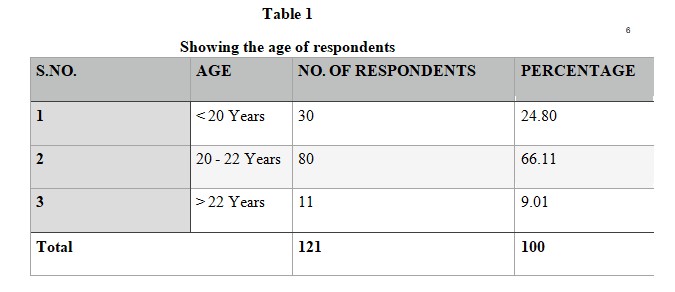
Table 1
Showing the age of respondents
(Source: Primary Data)
Table 1 shows the age breakdown of the respondents chosen for the research. It is known that a maximum of 80 respondents (66.11%) fell into the 20–22 age range, followed by 30 respondents (24.80%) who were under 20, and only 11 respondents (9.00%) who were over 22.
(Source: Primary Data)
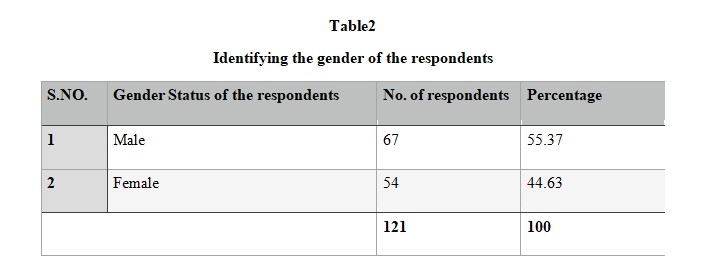
The gender distribution of the respondents chosen for the research is shown in Table 2. It is known that 67 respondents (55.37%) are male and that of 54 (44.63%) of the respondents are female.
(Source: Primary Data)
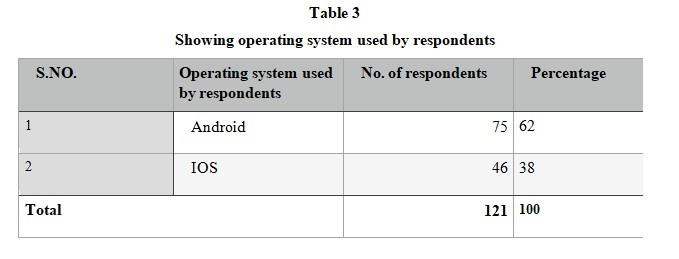
The operating system used by respondents chosen for the research is shown in Table 3. It is known that maximum of 75 respondents (62%) use android phones and that of 46 (38%) of the respondent use iPhone.
(Source: Primary Data)
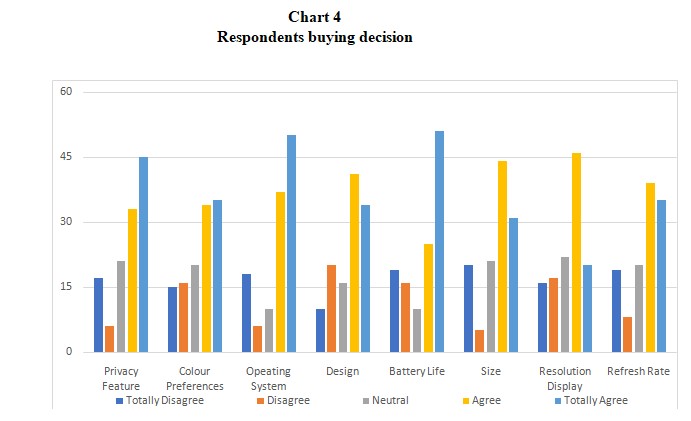
This diagram showing features which affects the buying decision of respondents.
(Source: Primary Data)
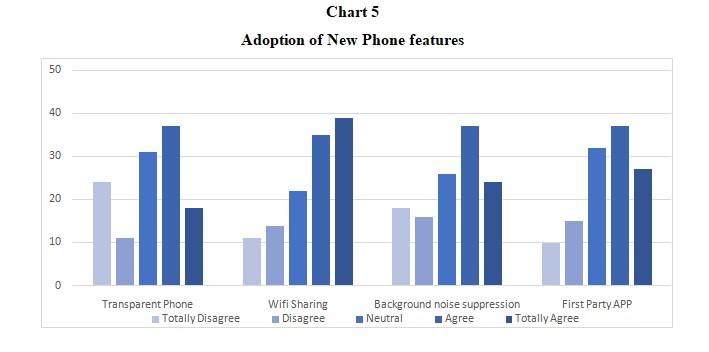
This diagram displays some of the new features that have received positive feedback and respondents’ positive responses in adopting new phone features. These features include Wi-Fi sharing, background noise suppression, and transparent displays.
Findings:
- Majority (66.11%) fell into the category of 20 to 22, whereas 24.80% fell into the category of those under the age 20, while 9.01% belonged to age category of 22 and above.
- 63% of the respondents are women, compared to more than half of the respondents being men which is 55.37%respondents.
- The majority of respondents used Android as their operating system which is 62%, as previously known.
- It was well known that a new transparent phone design is neither preferred nor opposed.
- It is known that respondents’ purchasing decisions are influenced by the privacy feature.
- Purchasing decision is primarily affected by the operating system of the phone from the comments we have seen.
- The elements that the 20- to 22-year-old age group prioritized were battery life, camera resolution, and internet speed because they primarily use their phones for content creation.
- High frequency of switching phones (every two to three years).
- Operating system, battery life, memory, and other features are those that consumers are most interested in and that have a big impact on their purchasing decisions.
- Wi-Fi sharing, background noise suppression, and transparent displays are some new features that have received favorable feedback.
- We can see from the comments that individuals think iOS, the operating system for iPhones, is more secure.
Suggestions:
- Access to Information: We have instant access to a wealth of knowledge through mobile devices. People now have easy access to news, research, educational materials, and other important tools thanks to smartphones and mobile data. This is crucial for young people who are learning and experimenting with new concepts.
- Communication: The use of mobile devices has significantly accelerated and improved communication. Youth can remain in touch with friends and family from anywhere in the world thanks to messaging apps and social media platforms. Additionally, this makes teamwork and collaboration in academic and professional situations simpler.
- Entertainment: From games to streaming services, the mobile industry has produced a wide range of entertainment choices for users. Youth can use this as a source of leisure and relaxation as well as a means to discover new interests and viewpoints.
- Convenience: The ability to accomplish tasks while on the go is one way that mobile devices have made our lives more convenient. Young people can easily complete important tasks from their mobile devices, from mobile banking to online purchasing.
- Innovation:Progress and growth in other sectors are fueled by the mobile industry’s constant innovation and pushing of boundaries. Early adopters of these new technologies among youth will be better positioned to navigate the future and take advantage of new possibilities.
Conclusion:
Our team’s study indicates that innovation in the mobile business has recently slowed down and that consumer acceptance of new innovations is high, which is bad for the future of any industry if innovation stops. Companies should continue to innovate, and for consumers to accept it, improvements should be subtle, approachable, and not gimmicky. It was known that Wi-Fi sharing, background noise suppression, and transparent displays are some new features that have received favorable feedback. We can see from the comments that individuals think iOS, the operating system for iPhones, is more secure.
References:
- Cecere, G., Corrocher, N., & Gossart, C. (2014). Innovation and competition in the smartphone industry: Is there a dominant design? Telecommunications Policy, 38(5-6), 413-431. doi: 10.1016/j.telpol.2013.11.007
- Manipon, O. N., & https://orcid.org/0000-0003-0104-5465, [email protected], Saint Mary’s University, Philippines. (2023). Effectiveness of ChemiCooking as A gamified intervention in nomenclature of compounds: Learning experiences of Grade 11 students in A public school. International Multidisciplinary Research Journal, 5(1), 1-10. doi: 10.54476/ioer-imrj/454889
- Grøtnes, E. (2009). Standardization as open innovation: Two cases from the mobile industry. Information Technology & People, 22(4), 367-381. doi: 10.1108/09593840911002469
- Androulidakis, I., & Kandus, G. (2011). Mobile phone brand categorization vs. users’ security practices. Engineering, Technology & Applied Science Research, 1(2), 30-35.
- Chaarlas, I. J., & Rajkumar, R. (2012). Brand switching – A conceptual analysis. THAVANIJRMM, 1(2), 1-5.
- Gruber, H., & Verboven, F. (2001). The evolution of markets under entry and standards regulation – the case of global mobile telecommunications. International Journal of Industrial Organization, 19(7), 189-213.
- Lee, J., Lee, J., & Feick, L. (2001). The impact of switching costs on the customer satisfaction-loyalty link: Mobile phone service in France. Journal of Services Marketing, 15, 35–48. doi: 10.1108/08876040110381463
- Oyeniyi, Omotayo, Abioudun, Omotayo, & Abiodun, Joachim. (2010). Switching cost and customers loyalty in the mobile phone market: The Nigerian experience. Business Intelligence Journal.
- Gireesan, E. M. (2017). Consumer behavior and factors influencing purchase decision of Xiaomi smart phones. International Journal of Interdisciplinary Research in Arts and Humanities, 2(2), 79-82