DHANGADHI, September 19: A strong call for climate justice, fair compensation for climate-related loss and damage, adequate grant-based climate finance and a just transition away from fossil fuels has been raised from Sudurpashchim Province of Nepal.
As part of the Global Week of Action for a Fossil-Free Future, youth, children, women, civil society representatives, people from gender and sexual minorities, persons with disabilities and representatives from different social sectors gathered in Dhangadhi to demand greater international accountability on the climate crisis.
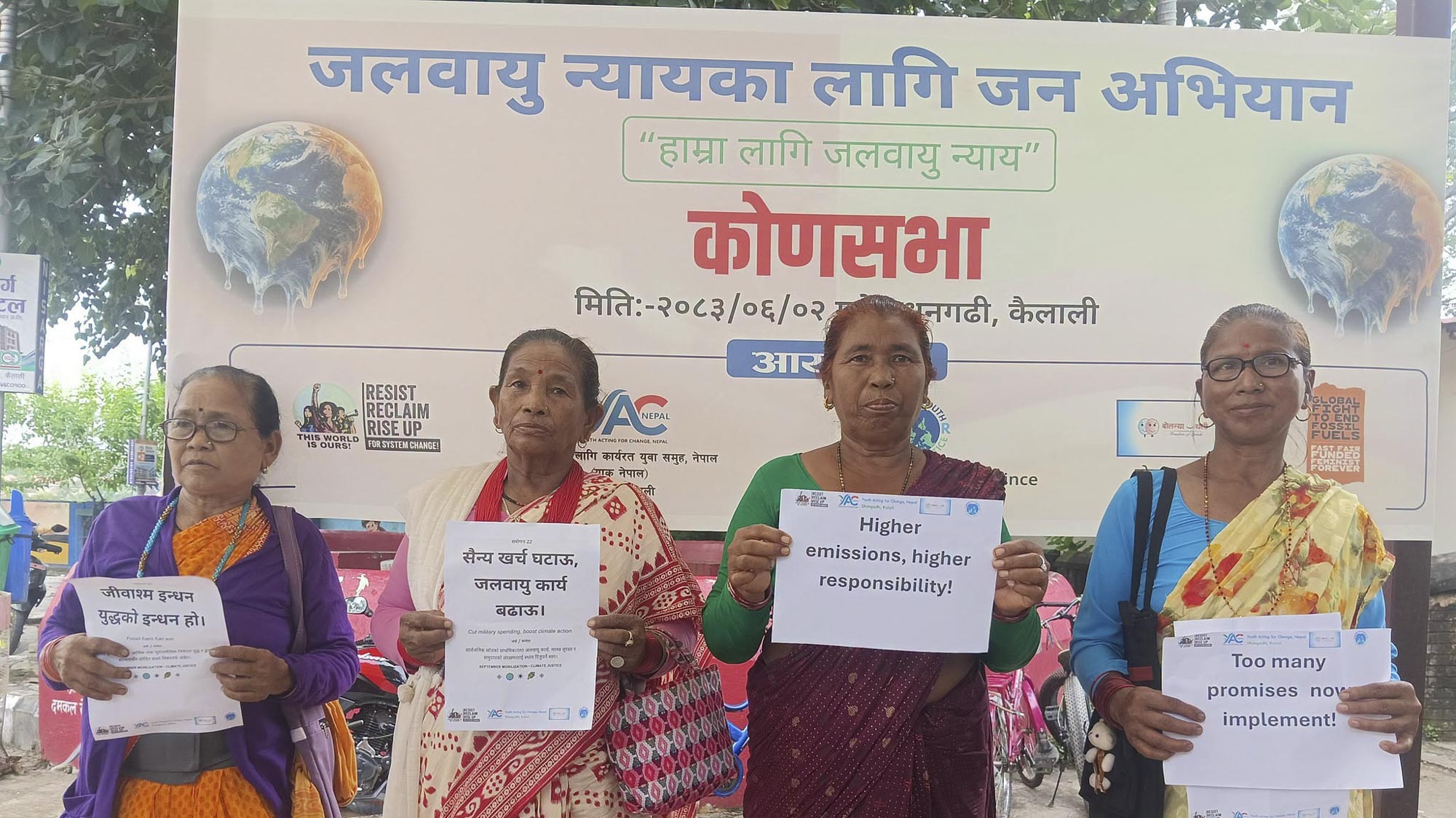
The program was organized at Park Mod along GEN-Z Marg in Dhangadhi Sub-Metropolitan City, Kailali. Participants held a pressure campaign featuring slogans, poster displays, a street assembly and discussions focused on climate justice.
Participants said the climate crisis is no longer only an environmental issue. It is increasingly affecting human lives, livelihoods, agriculture, food security, health, infrastructure, economies and social justice.
They said Nepal has contributed relatively little to global emissions but remains vulnerable to climate-related impacts. They called on the international community to recognize the rights and needs of communities already facing the consequences of climate change.
“Commitments were made. Now implement them.”
Participants called for international climate commitments to be translated into concrete action.
At COP27, countries agreed to establish funding arrangements and a dedicated fund for responding to loss and damage in particularly vulnerable developing countries. At COP28, the fund and related funding arrangements were operationalized.
However, participants said the key question remains how quickly and effectively these commitments are reaching communities affected by climate change.
They raised slogans including “Commitments were made, now implement them,” “Promises were made, now secure the finance,” and “Loss has occurred, now ensure justice for Loss and Damage.”
The campaign demanded that climate finance be adequate, accessible, transparent and predictable, and that financial resources for loss and damage reach affected communities quickly and through accessible mechanisms.
Participants also called for grant-based climate finance to be prioritized rather than creating additional debt burdens for developing countries.
Sudurpashchim experiencing the impacts of climate change
Sudurpashchim is geographically diverse, extending from the Himalayas through the hills to the Tarai plains. Communities across the province face risks from floods, landslides, inundation, drought, forest fires and other climate-related hazards.
Participants said communities affected by climate disasters need not only emergency relief but also long-term justice, financial support, social protection and stronger resilience.
They said rebuilding roads, bridges, houses and other physical infrastructure alone cannot constitute recovery. Restoring livelihoods and ensuring meaningful participation of affected communities in reconstruction are equally important.
Nepal’s recent disaster highlights the urgency
The campaign also drew attention to the devastating flood disaster in the Bhotekoshi–Trishuli river system on August 26.
The disaster caused extensive loss of life and damage to infrastructure, including roads, bridges, hydropower projects, homes and livelihoods. Government updates have reported thousands of deaths and missing people in the aftermath.
Participants said such disasters should not be viewed only as isolated emergencies. They called for long-term policies and international support to address growing climate risks.
Demand for a fossil-fuel-free future
Alongside climate justice, the Dhangadhi campaign also called for a just transition from fossil-fuel-dependent development towards renewable energy.
Participants demanded reduced dependence on coal, oil and gas, an end to public investment in fossil-fuel expansion and a worker-centred and gender-just transition to renewable energy.
Organizers said the action in Nepal is part of a wider Asian campaign involving countries including Bangladesh, India, Pakistan, Indonesia and the Philippines.
Eight-point demands from Sudurpashchim
The campaign put forward eight major demands:
1. Climate finance must be adequate, accessible, transparent and predictable.
2. Loss and Damage finance must reach affected communities quickly and through accessible mechanisms.
3. Grant-based climate finance should be prioritized over financing that creates additional debt.
4. High-emitting and wealthier countries should take immediate action to reduce emissions in line with their responsibilities.
5. Global emission reductions should be accelerated to keep the 1.5°C temperature goal within reach.
6. Youth, women, children, Indigenous Peoples, persons with disabilities, gender and sexual minorities and other vulnerable communities must have meaningful participation in climate decision-making.
7. UN and UNFCCC mechanisms should strengthen monitoring of climate commitments, financial flows and implementation.
8. The voices of climate-vulnerable developing countries must be placed at the centre of international climate decision-making.
Participants said climate justice should not be treated simply as charity or assistance. They described it as an issue of responsibility, equality and human rights.
The message from Sudurpashchim was directed beyond Nepal’s borders, calling for the concerns of climate-affected communities to reach national and international decision-making processes.
Their message was clear: the climate crisis cannot be solved through declarations alone. Commitments must now be translated into justice, finance and concrete action.
click here for more information……..